
Systems
Backend lead (Associate Engineer); web redesign
EV Charging Platform, Plugeasy
Core backend microservices for Plugeasy's EV charging platform, implementing OCPP 1.6 and OCPI for real-time charge point management, plus a full redesign of plugeasy.in with measured Core Web Vitals.
Stack
Python, FastAPI, OCPP 1.6, OCPI, MongoDB, AWS, Next.js, TypeScript, Tailwind CSS
Problem
Plugeasy needed backend services for real-time charge point management over OCPP 1.6 and OCPI, with APIs for the frontend, mobile apps and IoT charging devices, and a redesigned public site for its charging station management system.
Interface
Architecture
What I built
- Led core backend microservices in Python and FastAPI, implementing OCPP 1.6 and OCPI for real-time charge point management and interoperability.
- RESTful APIs connecting the frontend, mobile apps and IoT charging devices.
- MongoDB schema design, indexing, query optimisation and database automation for real-time charging session data.
- Deployed and maintained the services on AWS EC2, S3 and Lambda.
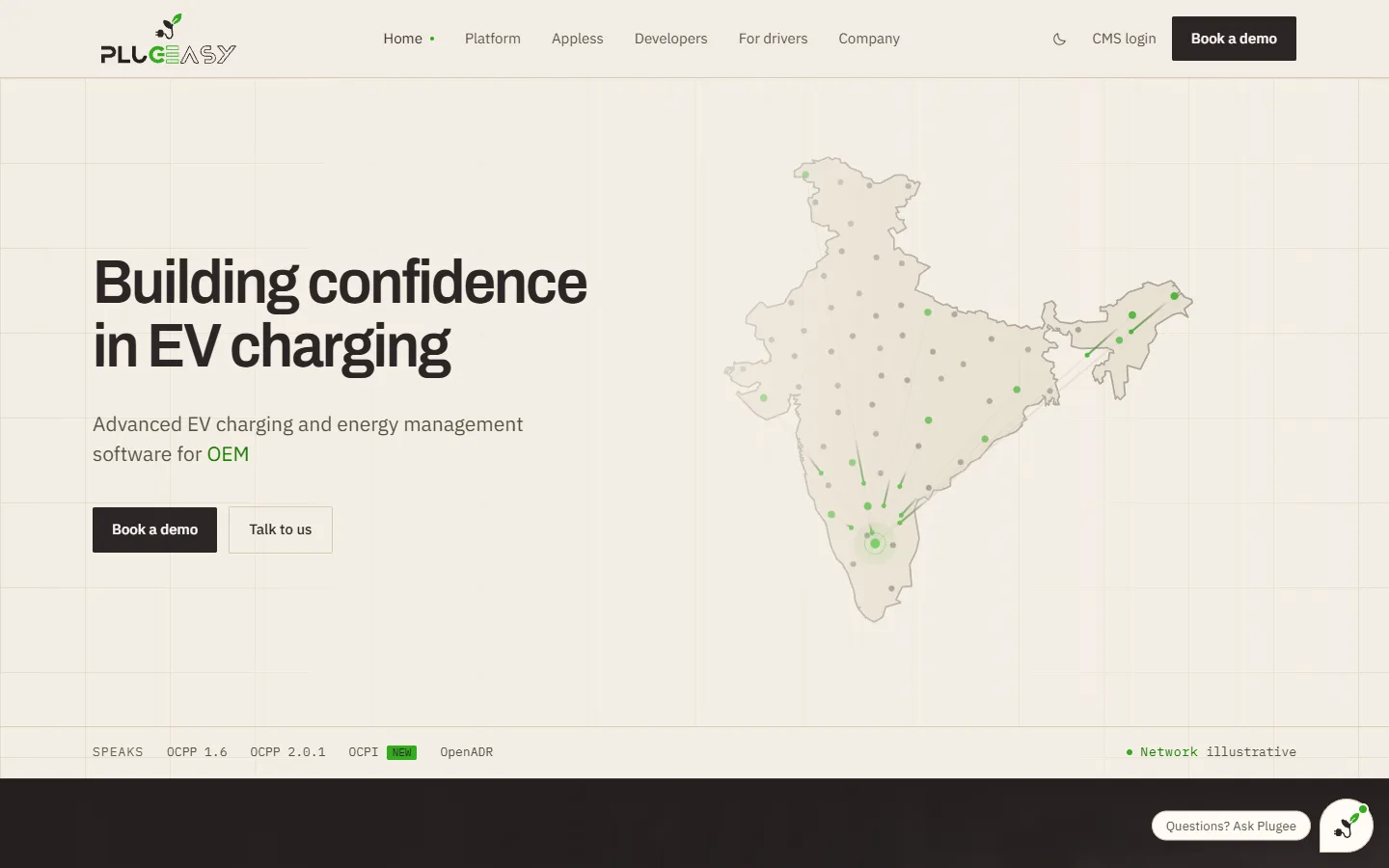
- Site redesign in Next.js: a canvas hero with a 60-node network over an India outline converging on Bengaluru, with a static SVG fallback for reduced motion.
- SEO and GEO: JSON-LD, generated llms.txt and llms-full.txt, and Markdown twins of each page served on Accept: text/markdown.
- A brand gate with five enforced rules, plus audits for accessibility, contrast per theme, performance, SEO and responsive layout across 7 routes and 9 widths.
Proof
- Brought the redesigned plugeasy.in to a largest paint of about 1.0 s with layout shift under 0.01
- Traced the logo to a crisp SVG at 99.4% overlap with the original (IoU 0.9936)
Stack
- Python
- FastAPI
- OCPP 1.6
- OCPI
- MongoDB
- AWS
- Next.js
- TypeScript
- Tailwind CSS
Share this case